

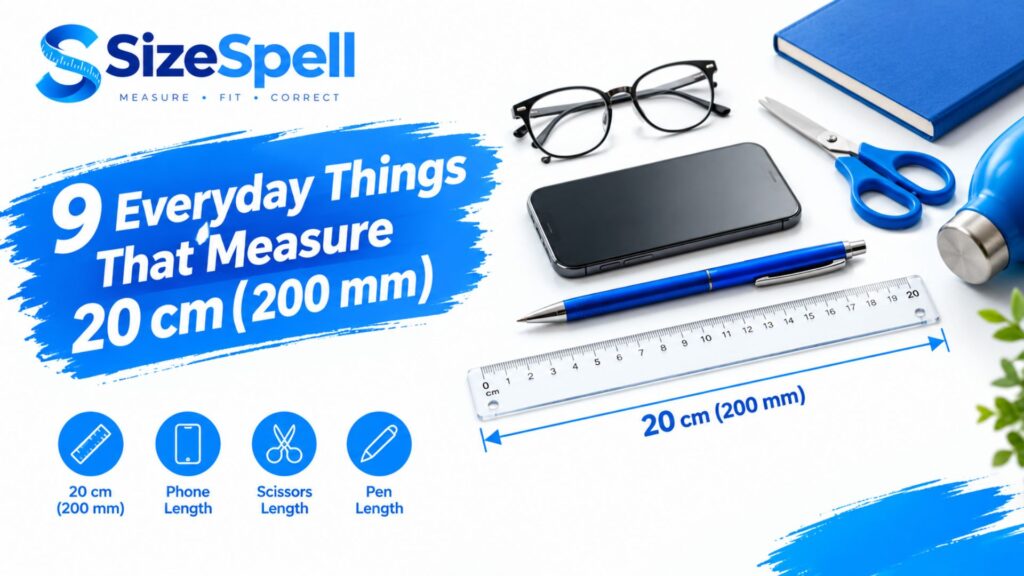
Twenty centimeters is one of those lengths you run into constantly without noticing. It is the width of a small plate, the length of a kitchen knife blade, and the diameter of a plant pot on a windowsill. Once you can picture 20 cm, you can estimate sizes in a shop, check a product listing, or plan a DIY job without reaching for a tape measure.
This guide explains exactly how long 20 cm is, how it converts to millimeters, inches and feet, and how it compares with objects you already know. You will also find nine real-world items that come in a nominal 20 cm (200 mm) size, a list of common measuring mistakes, and a few tricks for measuring 20 cm when you have no ruler at all.
A quick honesty note before we start. Manufactured goods are rarely “exactly” 20.000 cm. Sizes are usually nominal, meaning the label says 20 cm or 200 mm while the real part can differ by a millimeter or two. Where that matters, this article says so.
20 cm at a Glance
Here is the short version, written so you can grab it quickly.
- 20 cm equals 0.2 meters.
- 200 mm is the same length. Multiply centimeters by 10 to get millimeters.
- 7.87 in is the rounded inch value (7.874 in to three decimals). In fractions, that is just under 7 7/8 in.
- 0.66 ft is the rounded foot value (0.656 ft). That equals 0 ft 7.87 in.
A fast mental shortcut: 20 cm is about 8 inches. The true value is about 0.13 in (roughly 3 mm) shorter than 8 in, so the shortcut is fine for shopping but not for woodworking or machine parts.
20 cm Conversion Table
The inch is defined as exactly 2.54 cm, so every conversion below is simple arithmetic. Divide centimeters by 2.54 to get inches.
| Unit | Value for 20 cm | How to calculate |
| Millimeters | 200 mm | cm × 10 |
| Meters | 0.2 m | cm ÷ 100 |
| Inches | 7.874 in | cm ÷ 2.54 |
| Feet | 0.656 ft | inches ÷ 12 |
| Yards | 0.219 yd | meters ÷ 0.9144 |
| Feet and inches | 0 ft 7.87 in | whole feet plus remaining inches |
If you often switch between metric and imperial, this second table helps you see where 20 cm sits among its neighbors.
| Centimeters | Millimeters | Inches (rounded) |
| 5 cm | 50 mm | 1.97 in |
| 10 cm | 100 mm | 3.94 in |
| 15 cm | 150 mm | 5.91 in |
| 20 cm | 200 mm | 7.87 in |
| 25 cm | 250 mm | 9.84 in |
| 30 cm | 300 mm | 11.81 in |
Notice the pattern: every 5 cm adds almost exactly 2 inches. That is why 20 cm lands so close to 8 in.
How Big Is 20 cm?
Twenty centimeters is a hand-sized length. It is longer than a typical ballpoint pen, which is usually around 14 to 15 cm, and shorter than a sheet of A4 paper, which measures 21 cm by 29.7 cm. In other words, 20 cm is almost exactly the short edge of an A4 page, just 1 cm under it.
In the metric system, 20 cm is two decimeters. It is small enough to hold in one hand but large enough to be clearly visible across a desk. That balance is a big reason it shows up so often in product design, which we cover below.
What Does 20 cm Look Like?
Picture a few common things and you will get a feel for it:
- A new, unsharpened pencil is a little shorter, often about 19 cm.
- The blade of an 8-inch chef’s knife is 20.3 cm.
- Two credit cards laid end to end measure about 17 cm (each is 8.56 cm long), so you would need roughly another 3 cm to reach 20.
- Eight US quarters in a row come to about 19.4 cm (each is 24.26 mm wide).
Your own hand is also a useful reference, but only if you measure it once. Adult hand length, from the wrist crease to the tip of the middle finger, commonly falls somewhere between 17 and 20 cm. Measure yours and write the number down. After that you have a ruler that goes everywhere with you.
How Big Is 20 cm Compared to Everyday Objects?
The table below compares 20 cm with objects most people have at home. Sizes are typical, not universal, so treat them as close estimates.
| Object | Typical size | Compared with 20 cm |
| Credit card (long side) | 8.56 cm | About 43% as long |
| US dollar bill | 15.6 cm | About 4.4 cm shorter |
| Smartphone (height) | 14 to 17 cm | Slightly shorter |
| New standard pencil | about 19 cm | Roughly 1 cm shorter |
| Salad or side plate | 19 to 21 cm | About the same |
| 8-inch chef’s knife blade | 20.3 cm | Almost identical |
| A4 paper (short edge) | 21 cm | 1 cm longer |
| Dinner plate | 25 to 27 cm | 5 to 7 cm larger |
| 12-inch ruler | 30.48 cm | About two-thirds of it is 20 cm |
A useful rule: if something is about the length of a salad plate’s diameter, you are looking at roughly 20 cm.
Why 20 cm Is One of the Most Common Everyday Measurements
There are a few practical reasons this length appears so often.
It fits the human hand and arm. Handles, tools, and grips are comfortable at lengths people can hold and control. Twenty centimeters is a natural size for something you pick up with one hand.
It is a round metric number. Metric sizes tend to step in neat increments such as 10, 15, 20, 25 and 30 cm. Designers and factories like round numbers because they simplify tooling, packaging, and catalog listings.
It matches an imperial favorite. An 8-inch size equals 20.32 cm, so a single product can be sold as “8 in” in one country and “20 cm” in another with almost no redesign. This is why you often see 8-inch cake pans, 8-inch embroidery hoops and 8-inch saw blades sold alongside 20 cm or 200 mm versions.
It suits storage and shipping. A 20 cm square footprint fits neatly on shelves, in drawers, and in small shipping boxes.
That combination of ergonomics, round numbers, and metric-imperial overlap is what makes 20 cm such a handy reference length.
9 Things That Are Exactly 20 cm Long
Here is the honest part. Almost no mass-produced item is guaranteed to be exactly 20.00 cm, and specific branded products change dimensions between model years. So instead of naming brands whose sizes I cannot verify, the list below covers product types that are routinely made in a nominal 20 cm or 200 mm size. Always check the label or spec sheet of the exact product you plan to buy.
1. 200 mm Combination Square Rule
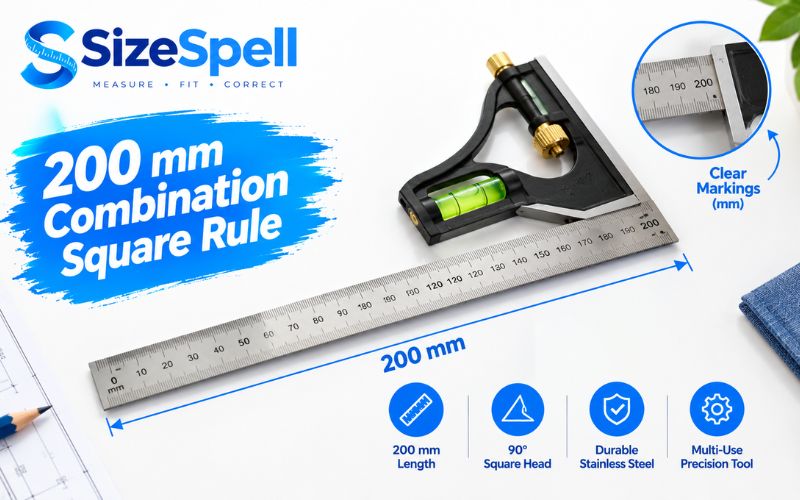
A combination square is a woodworking and metalworking tool that combines a ruler with a sliding head for marking right angles and 45-degree lines. Rules in this family come in several lengths, and 200 mm blades are a common metric option for small workshop tasks.
Why it is useful: the blade itself is a tidy 20 cm reference, and it is graduated in millimeters, so you can double-check other measurements against it.
Check before you buy: blade length is not always the same as overall tool length, because the head adds extra size.
2. 20 cm Drawer Organizer Tray

Drawer organizers and storage trays are often sold in modular widths, and 20 cm is a popular dimension for cutlery, stationery, and cosmetics trays. The reason is simple: standard kitchen and desk drawers are built around multiples of about 10 cm, so 20 cm trays tile neatly.
Check before you buy: measure the inside of your drawer. Trays labeled 20 cm may measure 19.5 cm or 20.5 cm once you account for wall thickness.
3. 200 mm Plant Pot

Gardening stores sell pots by top diameter, and 20 cm is a staple size. It suits herbs, small shrubs, orchids and houseplants. Plastic pots in this size are often molded to a nominal figure, so the true diameter may vary slightly.
Good to know: pot diameter usually refers to the rim, not the base. The base is narrower, so a 20 cm pot fits on a smaller saucer than you might expect.
4. 20 cm (8 in) Embroidery Hoop

Embroidery and cross-stitch hoops are usually sold by diameter. The 8-inch size equals 20.32 cm and is commonly listed as 20 cm. It is a favorite for wall-art projects because the stitched area is large enough for detailed designs but light enough to hold comfortably.
Good to know: the stitching area is smaller than the outer ring. Allow for the thickness of the frame when planning your pattern.
5. 200 mm Circular Saw Blade

Circular and miter saw blades are sold by outside diameter, and 200 mm is a recognized size in metric markets. The 8-inch blade is the imperial cousin at 203 mm.
Safety note: never swap blade sizes unless the saw’s manual explicitly allows it. Diameter, arbor hole size and maximum speed all have to match your tool.
6. 20 cm Stainless Steel Cake Ring

Bakers use cake rings and pans for shaping layered desserts, mousses, and tarts. An 8-inch, or about 20 cm, diameter is a standard home-baking size that serves around 8 to 12 slices depending on height.
Check before you buy: recipes written in inches and recipes written in centimeters can differ by 3 mm. That is rarely a problem for baking, but it can matter for acetate collars and fitted boards.
7. 200 mm PVC Pipe
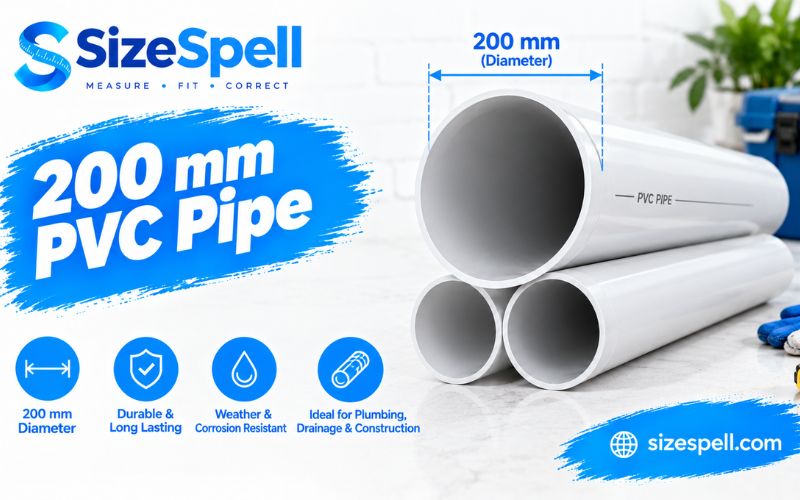
Plastic drainage and sewer systems include pipes with a nominal 200 mm size, along with matching couplings. This is a good example of why the word “nominal” matters. Pipe sizes can refer to outside diameter, inside diameter, or a standardized nominal designation depending on the system and country.
Check before you buy: read the product standard on the fitting and match it to the pipe. Two parts both labeled 200 mm are not automatically compatible.
8. 200 mm Round Air Vent Grille
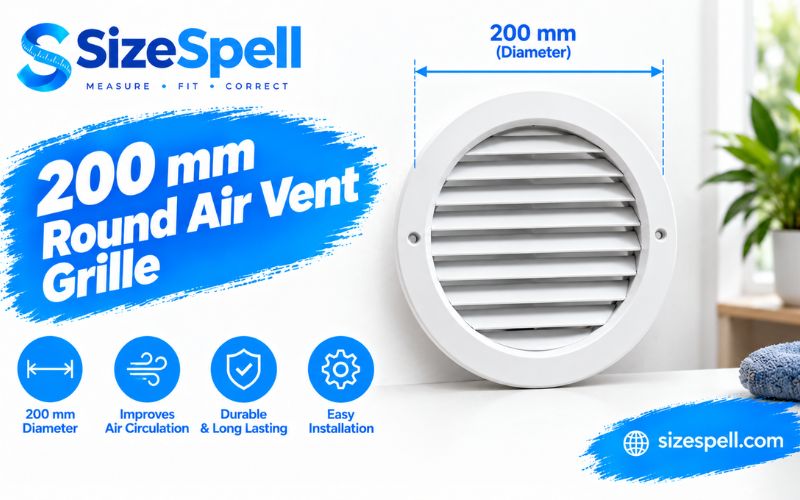
Round ducts for bathroom fans, kitchen extractors, and ventilation systems are commonly made in standard diameters such as 100, 125, 150, 200 and 250 mm. A 200 mm round grille or duct connector is a regular choice for larger spaces.
Good to know: the duct size you need depends on airflow requirements, not just on the hole in your wall.
9. 20 cm Silicone Stretch Lid

Reusable silicone lids stretch over bowls, jars, and containers to seal in food. Many brands sell sets that include a small, medium, and large lid, and a size around 20 cm suits typical mixing bowls and saucepans.
Good to know: because silicone stretches, a lid made for a 20 cm opening will often seal across a range of nearby sizes.
Quick Reference for the Nine Items
| # | Item | Measured as | Nominal size |
| 1 | Combination square rule | Blade length | 200 mm |
| 2 | Drawer organizer tray | Width or length | 20 cm |
| 3 | Plant pot | Top diameter | 200 mm |
| 4 | Embroidery hoop | Ring diameter | 20 cm (8 in) |
| 5 | Circular saw blade | Outside diameter | 200 mm |
| 6 | Cake ring | Diameter | 20 cm (8 in) |
| 7 | PVC pipe | Nominal diameter | 200 mm |
| 8 | Round air vent grille | Duct diameter | 200 mm |
| 9 | Silicone stretch lid | Lid diameter | 20 cm |
Also Read This 11 Everyday Items That Are Exactly 4 Inches Long
Related Measurement Guides
If you found this useful, the same approach works for neighboring lengths. A few ideas for guides worth reading next:
- What measures 10 cm and how to picture it
- Everyday objects that are 15 cm long
- Items that are 25 cm and how they compare with 20 cm
- How big is 30 cm and why it equals about one foot
- Converting centimeters to inches without a calculator
Each of these builds on the same skill: anchoring an abstract number to something you can see and touch.
Common Mistakes When Working With 20 cm
Even simple measurements go wrong in predictable ways. Watch for these.
- Mixing up 20 cm and 20 mm. One centimeter is ten millimeters, so 20 mm is only 2 cm. This is the most common slip when reading product specs.
- Treating 8 inches as exactly 20 cm. Eight inches is 20.32 cm. The 3 mm gap can stop a lid from fitting or a part from seating properly.
- Confusing diameter with length. A 20 cm pot has a 20 cm rim width, but it is not 20 cm tall. Always check which dimension a listing is quoting.
- Ignoring nominal sizes. Pipe, hoop, and blade sizes are often labeled by a standard name rather than a measured value.
- Measuring from the end of a worn ruler. Many rulers start at a small distance from the physical edge. Start from the 1 cm mark and subtract 1 cm if the end is damaged.
- Reading at an angle. Looking at a ruler from the side can shift your reading by a millimeter or more. Look straight down at the mark.
- Rounding too early. If you round 7.874 in to 7.9 in, then round again later, errors add up. Keep full precision until your final answer.
How 20 cm Compares to Common Household Items
This list is handy when you want a fast mental picture.
- Shorter than 20 cm: a credit card, a dollar bill, a ballpoint pen, a typical smartphone, a new pencil.
- About 20 cm: a salad plate, an 8-inch chef’s knife blade, an 8-inch cake pan, a small plant pot, the short side of an A4 sheet.
- Longer than 20 cm: a dinner plate, a 12-inch ruler, a standard sheet of letter paper (27.94 cm long), a large frying pan handle.
A photo print is another good example. The common 8 × 10 in size is about 20.3 × 25.4 cm, so its short edge is almost exactly 20 cm.
Where You’ll Commonly Find 20 cm Measurements
Once you start looking, 20 cm appears in a surprising number of places.
In the kitchen. Cake pans, salad plates, chef’s knives, small skillets and mixing bowl lids.
In the workshop. Small rules, squares, clamps, saw blades, and drill-press accessories.
In crafts and hobbies. Embroidery hoops, canvas boards, and sketchbooks. Many art supplies are sold in 20 × 20 cm or 20 × 25 cm formats.
In the home. Plant pots, drawer organizers, ceramic tiles (20 × 20 cm is a popular small tile size), and wall shelves.
In building and ventilation. Ducts, pipe fittings, vent covers, and fan housings.
In jewelry and fashion. Bracelet lengths often fall around 18 to 20 cm. Sizing varies by wrist, so always measure your own wrist and add a little room for comfort.
In packaging and shipping. Small boxes, mailers, and carton dimensions are often planned around 20 cm steps.
How to Measure 20 cm Without a Ruler
No ruler on hand? You have more options than you might think. These methods give approximate results, so use them for estimating rather than precision work.
Use a sheet of A4 paper
The short edge of A4 is 21 cm. Mark the edge, then subtract 1 cm, which is about the width of your little finger at the nail. This is the quickest and most reliable method if you have A4 paper.
Use a dollar bill
A US bill is 15.6 cm long. Add another 4.4 cm, roughly the width of a standard credit card’s shorter edge (5.4 cm) minus a little, and you are close to 20 cm. This works best for rough checks.
Use coins
Set eight US quarters edge to edge. Together they measure about 19.4 cm. Add a little extra for a margin and you have a handy 20 cm estimate.
Use your hand
Measure your hand length from wrist to fingertip once with a ruler. If it is 18 cm, you know that 20 cm is your hand plus a bit more than the width of two fingers.
Use a pencil
A new standard pencil is about 19 cm long. Add the width of your thumbnail for roughly 20 cm.
Use your phone
Most smartphone models list their dimensions online. If you know your phone’s height, you can lay it down and add the remaining distance. Many phones are between 14 and 17 cm, so you may need one phone length plus a few centimeters.
Quick steps to verify
- Choose your reference object.
- Mark the start point with a finger or pencil.
- Move the object along the surface without leaving gaps.
- Add any extra distance you calculated.
- If accuracy matters, check the result against a real ruler later.
Frequently Asked Questions About 20 cm
How many inches is 20 cm?
20 cm equals 7.874 inches, usually rounded to 7.87 in. To convert any centimeter value to inches, divide by 2.54.
Is 20 cm the same as 8 inches?
Not quite. Eight inches is 20.32 cm, so it is about 3 mm longer than 20 cm. The two are close enough for casual use, but not for precise fitting work.
How many millimeters are in 20 cm?
There are 200 mm in 20 cm. Multiply centimeters by 10 to get millimeters.
How many feet is 20 cm?
20 cm is about 0.656 ft. In feet and inches, that is 0 ft 7.87 in.
What everyday object is about 20 cm long?
A salad plate, the blade of an 8-inch chef’s knife, and a new pencil (about 19 cm) all come close. The short edge of an A4 sheet is 21 cm, which is only 1 cm more.
How can I convert 20 cm to inches in my head?
Multiply by 0.4 to get 8 in, then subtract a little more than 0.1 in. That gives you roughly 7.9 in, which is close to the exact 7.87 in.
Is a standard school ruler 20 cm long?
Rulers are sold in several lengths, and 20 cm versions exist. The 30 cm (12 in) ruler is the more common standard, so a 20 cm mark sits about two-thirds of the way along it.
What is the quickest way to measure 20 cm without a ruler?
Use the short edge of an A4 sheet, which is 21 cm, and subtract about 1 cm. It is the fastest method if you have A4 paper nearby.
Conclusion
Twenty centimeters, or 200 mm, is about 7.87 inches and 0.66 feet. It sits in a convenient middle zone: bigger than a pen, close to an 8-inch kitchen blade, and almost the same as the short side of an A4 page. That makes it easy to remember and easy to find.
The nine product types in this guide, from combination square rules to silicone lids, show how often manufacturers choose a nominal 20 cm size. Just remember that nominal is not the same as exact. Before buying anything where fit matters, check the actual dimensions on the product’s label or spec sheet.
Now try this: find one object in your home that you trust to be 20 cm, confirm it with a ruler, and keep it as your personal reference. The next time you need to judge a length, you will already have a feel for it.

1 thought on “9 Everyday Things That Measure 20 cm (200 mm)”