


Picture a long hallway, a field behind a house, or a boat dock. Someone says it is about 100 feet. Is that a short walk or a long one? For most of us, the number alone does not mean much.
That is the problem this guide solves. You will learn exactly how long 100 feet is, how it converts to meters and yards, and how it fits on a football field. You will also see eight real-world comparisons, from a blue whale to a row of parked cars. At the end, you will find three simple ways to measure 100 feet when no tape is nearby.
One honest note first. The headline of many “100 feet” lists says “exactly,” but very few real objects are exactly 100 feet. Whales, planes, and buildings vary. So in this guide, every comparison is labeled as a close match, a near miss, or not a match. That way you can trust each picture you build in your head.
How Long Is 100 Feet?

100 feet equals 30.48 meters, 1,200 inches, or 33.33 yards. That is about 0.019 of a mile. It is a little longer than a basketball court and about the length of eleven parking spaces side by side.
The conversion is exact. One foot is defined as exactly 0.3048 meters, so 100 × 0.3048 gives 30.48 with nothing left over.
Here are the quick facts to remember:
- 100 feet is 33⅓ yards, or one third of the distance between the goal lines on an American football field.
- 100 feet is about 30 meters, which is easy to hold in your head.
- At a normal walking pace, you cover 100 feet in roughly 23 seconds.
- Most adults take about 40 steps to cover it.
- It is roughly the height of a ten-story building.
Why does this length come up so often? Because it is a common standard in the real world. Long measuring tapes often come in 100-foot reels. Garden hoses and extension cords are sold in 100-foot lengths. Fire safety guides in wildfire areas often talk about clearing vegetation up to 100 feet from a home. So you meet this number whether you are building a fence, planning a yard, or watering a lawn.
Conversion Table
A chart saves time when you switch between systems. The first table converts 100 feet into other common units.
| Unit | Equivalent of 100 feet |
| Inches | 1,200 in |
| Yards | 33.33 yd |
| Meters | 30.48 m |
| Centimeters | 3,048 cm |
| Millimeters | 30,480 mm |
| Kilometers | 0.03048 km |
| Miles | 0.0189 mi |
The second table shows nearby lengths, so you can see where 100 feet sits in a sequence.
| Feet | Meters | Yards |
| 50 ft | 15.24 m | 16.67 yd |
| 75 ft | 22.86 m | 25 yd |
| 90 ft | 27.43 m | 30 yd |
| 100 ft | 30.48 m | 33.33 yd |
| 110 ft | 33.53 m | 36.67 yd |
| 120 ft | 36.58 m | 40 yd |
| 150 ft | 45.72 m | 50 yd |
| 200 ft | 60.96 m | 66.67 yd |
Simple Formulas
To turn feet into meters, multiply by 0.3048. To turn meters into feet, divide by 0.3048.
Need a mental shortcut? Multiply the feet by 0.3. For 100 feet, that gives 30 meters. The real answer is 30.48, so the shortcut is off by about 1.6 percent. That is close enough for planning a garden bed or judging a swimming pool.
Going the other way, 30 meters is 98.4 feet, and 100 meters is 328.1 feet. If a product listing says 30 m, you can treat it as roughly 100 feet.
Understanding 100 Feet
Numbers feel abstract until you attach them to something familiar. Three ideas help: use whole-number groups, think in steps, and think in time.
Groups. Break 100 feet into smaller pieces you already know. Two 50-foot lengths make 100. Ten 10-foot lengths make 100. A 10-foot length is about the height of a basketball hoop, so a hundred feet is ten hoops stacked end to end.
Steps. A typical adult step is around 2.5 feet. So 100 feet takes about 40 steps. Shorter people may take 45, and taller people may take 38. You can find your own number in a minute, and the measuring section below shows how.
Time. A relaxed walking pace is about 3 miles per hour, or 4.4 feet per second. That means 100 feet takes about 23 seconds. A slow stroll with a dog could take 35 seconds or more.
Here is a simple table that sums it up.
| How you cover it | Approximate result |
| Walking steps | About 40 steps |
| Walking time | About 23 seconds |
| Arm spans (a 5-foot-8 person) | About 18 |
| Standard 12-inch floor tiles | 100 tiles |
| Adult shoe lengths | About 100 |
How Much of a Football Field Is 100 Feet?
An American football field is 100 yards between the goal lines. That is 300 feet. With the two 10-yard end zones, the full field is 120 yards, or 360 feet.
So 100 feet is exactly one third of the playing field between the goal lines. It is 33.33 yards, a little more than three first-down chains. A first down needs 10 yards, or 30 feet, so 100 feet is three and a third first downs.
| Field measure | In feet | 100 feet as a share |
| Between goal lines (100 yd) | 300 ft | 33.3% |
| Full field with end zones (120 yd) | 360 ft | 27.8% |
| One 10-yard first down | 30 ft | 3.33 of them |
| Width of the field (53⅓ yd) | 160 ft | 62.5% |
A small warning: people often mix up 100 feet and 100 yards. They are very different. A hundred yards is 300 feet, or three times as far. Always check the unit before you cut, buy, or plan.
Also Read This 16 Everyday Things That Are About 7 Inches Long
What 100 Feet Feels Like
Seeing a distance is one thing. Feeling it is another. These comparisons use the senses to make 100 feet real.
- In your voice. You can talk normally with a friend at 10 feet. At 100 feet, you must raise your voice to be heard. Many people shout at this distance without thinking.
- In your sight. At 100 feet, you can read a large road sign and recognize a friend by shape and walk. Fine details like small print or facial expression start to fade.
- In your throw. A baseball thrown from third base to first base covers about 127 feet. A throw between adjacent bases covers 90.
- In your stride. Walk to the end of a typical suburban street lot, and you have probably covered 100 to 150 feet. Many front yards are 20 to 40 feet deep, so imagine three or four houses in a row.
- In your car. At 30 miles per hour, a car travels 44 feet each second. So 100 feet passes in a little over two seconds.
The car example is worth remembering. At 60 miles per hour, a car moves 88 feet per second. So you cover 100 feet in about 1.1 seconds. That is why even a short gap in traffic matters at highway speed.
8 Things That Are About 100 Feet Long
Below are eight comparisons. Some come very close to 100 feet. Others are useful but not a match. The table shows which is which, and the sections after it explain each one.
| # | Comparison | Actual figure | Match |
| 1 | Blue whale (longest reliably measured) | About 98 ft | Close |
| 2 | Ten-story building | About 100 ft at 10 ft per floor | Close |
| 3 | Boeing 737 | 94 to 117 ft wingspan, 102 ft (737-500) length | Varies |
| 4 | Statue of Liberty pedestal | About 89 ft (154 ft with foundation) | Near miss |
| 5 | Niagara Falls (Horseshoe Falls) | About 167 ft | Not a match |
| 6 | Buses lined up | 2.5 transit buses or 3 school buses | Close |
| 7 | Parking spaces in a row | 11 spaces at 9 ft each = 99 ft | Close |
| 8 | Football field section | 33.3 yd | Exact |
1. Blue Whale (Maximum Recorded Length)
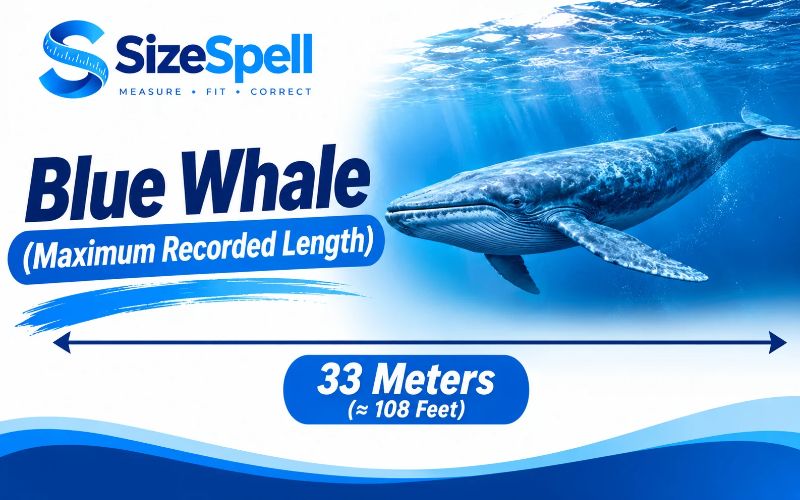
The blue whale is often called “a hundred feet long.” The truth is a bit smaller. The longest blue whale ever measured with reliable methods was a female of about 98 feet, recorded in Antarctic waters in 1947. Whalers sometimes claimed 100 feet or more, but those numbers were often rough or exaggerated.
Modern drone measurements suggest most living blue whales are shorter. Many fall between 70 and 85 feet, depending on the ocean region. Antarctic whales tend to be larger than those in the North Pacific.
So a blue whale is a close match only at its absolute maximum. Even so, it is one of the best ways to feel the scale. Picture an animal as long as a bowling lane and then some.
2. 10-Story Building (10 Feet Per Floor Standard)

A common rule of thumb says one story is about 10 feet. Ten stories make 100 feet. It is a quick estimate that architects and engineers use for early planning.
Real buildings vary. Homes and apartments often have 9 to 10 feet per floor. Office buildings and shops often use 12 to 14 feet because of ceiling systems and ducts. So a real ten-story office tower may reach 120 to 140 feet.
Still, a ten-story building is the easiest way to picture 100 feet of height. Look at a mid-rise apartment block downtown. That is roughly what you are imagining.
3. Boeing 737 Wingspan

The Boeing 737 is one of the most common passenger jets in the sky. Its numbers are close to 100 feet, though not always exact.
Boeing lists the 737-700, 737-800, and 737-900 with a wingspan of 117 feet 5 inches. Older “classic” models such as the 737-300 through 737-500 have a wingspan of about 94 feet 9 inches. The shortest classic version, the 737-500, is about 102 feet long from nose to tail.
So if you stand at one wingtip of a modern 737, you are about 17 feet beyond the 100-foot mark. If you walk the fuselage of an old 737-500, you are almost exactly there. It is a handy comparison, but check the model before you quote it.
4. Statue of Liberty Pedestal Height
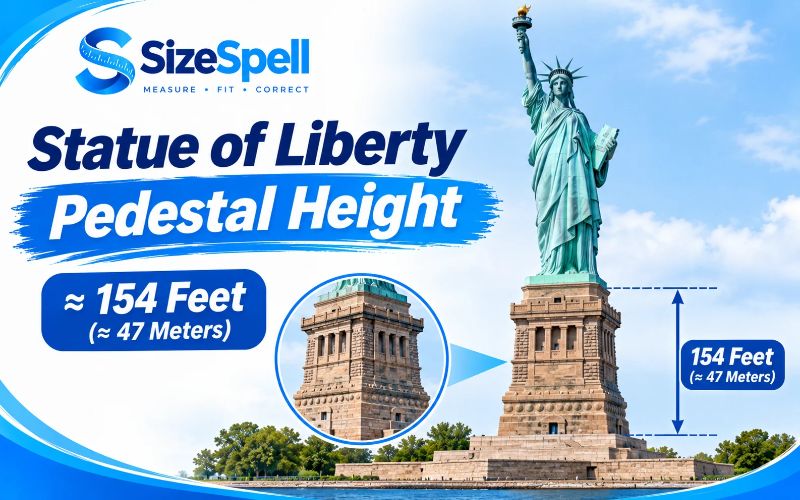
The Statue of Liberty is a famous landmark, and its numbers are easy to mix up. The statue itself, from the heel to the tip of the torch, is about 151 feet. The pedestal that holds it is about 89 feet tall. The foundation beneath it adds roughly 65 feet, for a combined 154 feet. The total from the base of the foundation to the torch tip is about 305 feet.
So the pedestal alone is an 89-foot near miss. If you add a few more steps, you get 100 feet. It is still a useful picture, especially if you have visited Liberty Island and remember climbing the pedestal stairs.
5. Niagara Falls (Horseshoe Falls Height)

Niagara Falls is often used as a size comparison, but it is not a good match for 100 feet. The Horseshoe Falls drops about 167 feet, which is nearly one and two-thirds times as much.
This is a good example of why you should check figures. Many sources round numbers or blend the heights of different falls. The Horseshoe Falls is also about 2,700 feet wide, so its width is the better thing to talk about.
Use it as a contrast. A 100-foot drop is about 60 percent of the Horseshoe Falls. Picture the falls and imagine the top 40 percent sliced off.
6. Four City Buses Lined Up

A standard full-size transit bus is about 40 feet long. That means 100 feet equals two and a half buses. Four buses would be about 160 feet, which is too long.
School buses are a closer match. A common full-size school bus is about 35 feet. Three of them, bumper to bumper, make roughly 105 feet. Shorter shuttle buses of about 25 feet fit four to a hundred.
The takeaway is simple. For a bus-based picture, think “two and a half transit buses” or “three school buses.” That is easy to see at a stop or a depot.
7. Parking Spaces in a Row (Standard Lot Layout)
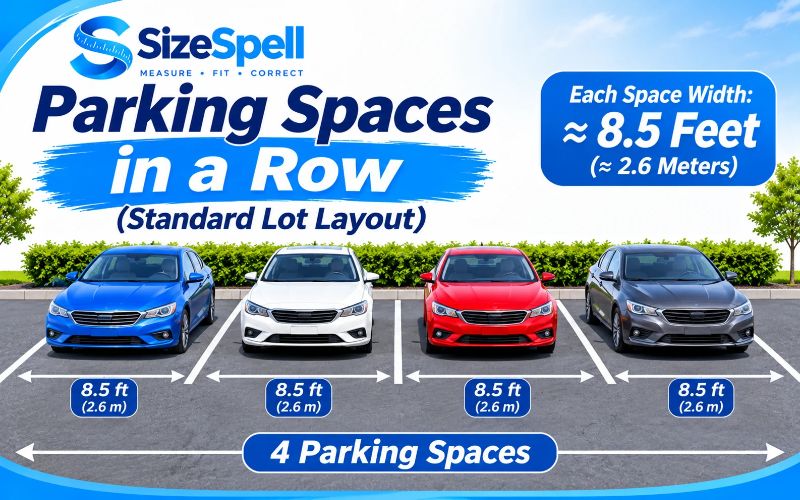
This is a great everyday comparison. A standard parking space is about 9 feet wide. Eleven of them in a row measure 99 feet, which is as close to 100 feet as you can get.
Many places use 8.5 feet or 9 feet. At 8.5 feet, twelve spaces cover 102 feet. Compact stalls may be narrower, and accessible stalls are wider, so check your own lot.
Next time you are at the mall, look down a row. When you reach the eleventh space, you are standing at roughly 100 feet.
8. Football Field Section (NFL Regulation Context)
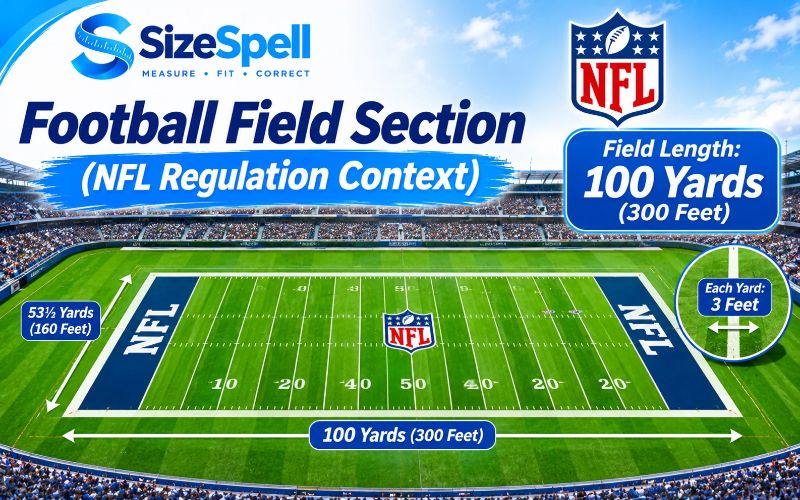
The playing field between the goal lines is 300 feet, so exactly one third of it is 100 feet. Start at one goal line and walk to the 33⅓-yard point. In practice, that is just past the 30-yard line.
This is an exact match, not a rounded one, which is why it works so well for sports fans. If you can picture a quarterback dropping back and handing off near the 30-yard line, you can picture 100 feet.
More Ways to Picture 100 Feet
The next four sections look at 100 feet from different angles: its size, its height, its distance, and how it compares with other things.
How Big Is 100 Feet?
Length is only one way to describe size. These figures assume 100 feet is the side of a shape.
| Shape | Measurement | Result |
| Square (100 ft sides) | Area | 10,000 square feet |
| Square (100 ft sides) | Area in acres | About 0.23 acres |
| Circle (100 ft diameter) | Circumference | About 314 ft |
| Circle (100 ft diameter) | Area | About 7,854 square feet |
A 100-by-100 foot square is about 0.23 of an acre. An acre is 43,560 square feet, so you would need more than four such squares to fill one. It is also close to the size of a large suburban lot in many places.
How Tall Is 100 Feet?
Height feels different from length because you tilt your head back. A 100-foot height is about:
- A ten-story building at 10 feet per floor.
- About 17 or 18 average adults standing on each other’s shoulders, at roughly 5.7 feet each.
- Five to six adult giraffes stacked, since a giraffe stands about 16 to 19 feet tall.
- A mature tree in many forests. Coast redwoods often reach 200 feet or more, so a 100-foot tree is only a mid-sized one.
If you are judging a tree for safety, this matters. A tree 100 feet tall can reach over a house 50 feet away and still have room to spare. That is why arborists talk about fall zones.
How Far Is 100 Feet?
As a distance, 100 feet is short enough to cover in under half a minute, yet long enough that you notice it. Here are some practical examples.
- A standard garden hose is often 50 or 100 feet long. A 100-foot hose reaches from the faucet to the far fence in many yards.
- A 100-foot extension cord is a common choice for outdoor power tools.
- A long fire hose line often runs in lengths of 50 or 100 feet.
- Many wildfire-safety programs recommend clearing flammable plants out to 100 feet around a building.
100 Feet Comparison
This table puts 100 feet next to the sizes you see in sports, transport, and nature.
| Item | Length | Difference from 100 ft |
| Horseshoe Falls height | 167 ft | 67 ft taller |
| Statue of Liberty (heel to torch) | 151 ft | 51 ft taller |
| Boeing 737-800 length | 129.5 ft | 29.5 ft longer |
| Three school buses | About 105 ft | 5 ft longer |
| Boeing 737-500 length | About 102 ft | 2 ft longer |
| Eleven parking spaces | 99 ft | 1 ft shorter |
| Longest measured blue whale | About 98 ft | 2 ft shorter |
| NBA basketball court | 94 ft | 6 ft shorter |
| Baseball base path | 90 ft | 10 ft shorter |
| Statue of Liberty pedestal | About 89 ft | 11 ft shorter |
| Tennis court | 78 ft | 22 ft shorter |
| Semi-truck with trailer | About 70 ft | 30 ft shorter |
The pattern is clear. Standard sports courts and fields run a little under 100 feet. Planes and buses are right around it. Famous landmarks such as the Statue of Liberty or Niagara Falls are well above it.
How to Measure 100 Feet Without a Tape Measure
You do not need special tools. Here are three methods that work with just your body or the floor beneath you. Each has a different level of accuracy.
Method 1: Steps
This is the fastest way outdoors. First, find your personal step length. Then use it as a ruler.
- Mark a known 25-foot distance on a flat surface. A tape measure or a 25-foot garage is fine for this one-time test.
- Walk it at your normal pace and count your steps.
- Divide 25 by the number of steps. That is your step length in feet.
- Divide 100 by that number. That is how many steps make 100 feet.
For example, if you take 10 steps to cover 25 feet, your step is 2.5 feet. So 100 feet is 40 steps.
Keep your steps natural. Do not stretch. Do this on level ground, since slopes and rough surfaces change your stride. A repeated test improves accuracy to within about 3 to 5 percent for most people.
Method 2: Floor Tiles
Indoors, tiles give you a ready-made grid. This works well in hallways, gyms, and shops.
| Tile size | Tiles needed for 100 ft |
| 12 inches | 100 tiles |
| 16 inches | 75 tiles |
| 18 inches | About 67 tiles |
| 24 inches | 50 tiles |
Count along one row in a straight line. Include the grout lines in your count, and note that the real tile size may be a little smaller than the label. Many “12-inch” tiles are about 11.75 inches wide before grout. For a rough check, this works well. For a precise cut, use a tape.
Method 3: Body Measurement
Your body is a built-in ruler. Two body measures are especially useful.
- Arm span. Your arm span from fingertip to fingertip is roughly equal to your height. If you are 5 feet 8 inches tall, 100 feet is about 18 arm spans.
- Shoe length. An adult shoe is about 12 inches. Walk heel to toe, and about 100 shoe lengths make 100 feet. This is slow, but it is accurate if your shoes are close to a foot long.
Measure your own arm span against a wall once and write the number on your phone. Then you will always have a personal ruler.
If you need real accuracy, there are better choices. A 100-foot open-reel tape, a measuring wheel, or a laser distance meter is quick and cheap. A phone app can help, but its accuracy varies, so check it against a known length first.
FAQs
How many meters is 100 feet?
100 feet is exactly 30.48 meters. Multiply the feet by 0.3048.
How many yards is 100 feet?
100 feet is 33.33 yards. Divide the feet by 3.
How many steps is 100 feet?
Most adults take about 40 steps to cover 100 feet. Your own number depends on your height and pace.
Is 100 feet the same as 100 yards?
No. 100 yards is 300 feet, which is three times as far as 100 feet.
How tall is a 10-story building in feet?
At about 10 feet per floor, a 10-story building is roughly 100 feet tall. Real buildings can be taller, since many floors are 12 feet or more.
What common thing is closest to 100 feet?
One third of an American football field between the goal lines is exactly 100 feet. Eleven standard parking spaces side by side, at about 9 feet each, are very close at 99 feet.
Conclusion
100 feet is 30.48 meters, 1,200 inches, or 33⅓ yards. It is one third of a football field, about 40 steps, and roughly the height of a ten-story building. It takes about 23 seconds to walk and just over a second to pass in a fast car.
The eight comparisons in this guide give you plenty of anchors. A section of football field is an exact match. A row of eleven parking spaces and a ten-story building are very close. A blue whale, a school-bus line, and a Boeing 737 come near. The Statue of Liberty pedestal and Niagara Falls are useful mainly as contrasts.
Use the conversion tables when you switch between feet and meters. Use steps, tiles, or your arm span when you have no tape. And when accuracy matters, grab a real measuring tape or a laser meter. With a few reference pictures in mind, you will always have a feel for how long 100 feet is.

1 thought on “8 Everyday Things Around 100 Feet Long”