


Two hundred feet is one of those distances that sounds simple until you try to picture it. A contractor mentions a 200-foot fence run. A drone manual says to stay under 200 feet. A neighbor says the property line is “about 200 feet back.” Your brain nods along, but you have no clear mental image.
So, how long is 200 feet? 200 feet equals 60.96 meters, 66.67 yards, or 2,400 inches. It is roughly the length of five 40-foot shipping containers, a standard NHL hockey rink, or a 20-story building laid on its side.
This guide gives you the exact conversions, nine comparisons you can actually visualize, and three ways to measure 200 feet when you have no tape measure in your hand. Every comparison here is checked against published dimensions, and where a number varies by source, I say so.
How Long Is 200 Feet?
Two hundred feet is a little over 3.5% of a mile. That makes it a short distance on a map and a surprisingly long one when you have to stretch a hose, run a cable, or walk it with a heavy bag.
Here is the quick answer in the units people search for most:

- Meters: 60.96 m
- Yards: 66.67 yd
- Inches: 2,400 in
- Centimeters: 6,096 cm
- Miles: about 0.038 mi
- Kilometers: 0.061 km
The math behind these is simple. One foot is exactly 0.3048 meters by international agreement, so 200 × 0.3048 gives 60.96 meters. One yard is three feet, so you divide 200 by 3 to get 66.67 yards.
A handy shortcut: 200 feet is just a bit more than 60 meters. If you want a fast mental estimate, multiply feet by 0.3 and you will land very close.
Conversion Table
Use this table when you need the number in a different unit. Bookmark it if you work with mixed measurement systems.
| Unit | Equal to 200 feet |
| Inches | 2,400 in |
| Yards | 66.67 yd |
| Meters | 60.96 m |
| Centimeters | 6,096 cm |
| Millimeters | 60,960 mm |
| Kilometers | 0.06096 km |
| Miles | 0.0379 mi |
| Nautical miles | 0.0329 nmi |
If you need to go the other direction, 200 meters is about 656 feet, which is more than three times longer. People mix up 200 feet and 200 meters all the time, and in construction or travel planning that mistake gets expensive.
What 200 Feet Feels Like
Numbers only help so much. Here is how the distance feels in daily life:
- Walking: At an easy pace of about 3 miles per hour, you cover 200 feet in roughly 45 seconds.
- Jogging: At a steady 10 minutes per mile, it takes about 23 seconds.
- Counting steps: An average adult step is around 2.5 feet, so 200 feet is close to 80 steps.
- Shouting: You can hold a normal conversation at 10 feet. At 200 feet you would need to raise your voice to be understood.
Practical Ways to Visualize 200 Feet
Before the full list, here are the anchors I use most. They come from everyday objects with known sizes:
- Average car: about 15 feet long, so 200 feet is roughly 13 cars bumper to bumper.
- Bowling lane: 60 feet from foul line to head pin, so 200 feet is a little over three lanes.
- Baseball diamond: bases sit 90 feet apart, so 200 feet is just over two base paths.
- Basketball court: an NBA court is 94 feet long, so 200 feet is about two courts.
- Semi-truck with trailer: around 70 feet, so you would line up close to three of them.
Pick the one you know best and keep it in your head. Then use the nine comparisons below for a deeper picture.
9 Things That Are About 200 Feet Long
A quick honesty note before we start. Many “200 feet” lists online claim exact matches that do not hold up. Niagara Falls is not 200 feet tall, and a football field is not 200 feet long. I corrected those below and used comparisons that genuinely line up.
1. Five ISO Shipping Containers

The standard shipping container is 40 feet long. Line up five end to end and you have exactly 200 feet.
You have seen these stacked at ports, on trains, and on the backs of trucks. Picture five of them in a row, and you have a very accurate image of the distance. Smaller 20-foot containers work too: ten of them make 200 feet.
One caution. Some containers are 45 or 53 feet long, especially in domestic trucking, so check the type before you do your math.
2. Four 50-Foot Railroad Boxcars
A common railroad boxcar runs about 50 feet in length. Four of them coupled together stretch 200 feet.
Boxcar lengths vary, from about 40 feet on older cars to 60 feet on newer ones, so treat this as a close match rather than an exact one. Still, if you have ever waited at a crossing and counted cars, you have a feel for this distance. Count four cars and you are looking at roughly 200 feet of train.
3. The Wright Brothers’ Third Flight

This one is a fun piece of history. On December 17, 1903, Orville and Wilbur Wright made four flights at Kitty Hawk, North Carolina. According to the National Park Service, the first flight covered 120 feet in 12 seconds, the second about 175 feet, and the third about 200 feet in 15 seconds. The fourth and longest went 852 feet in 59 seconds.
So the third flight of the first powered airplane in history was about 200 feet. Think about that next time you walk the length of a parking lot. You just covered the distance that once made headlines.
4. A Portland City Block

Downtown Portland, Oregon, is famous for its short blocks, which measure about 200 feet by 200 feet. Walk from one corner to the next and you have walked about 200 feet.
Manhattan is a bit different. A typical cross-street block there runs somewhere between 200 and 260 feet, depending on whether you count only the building frontage or the width of the street as well. So if you live in a big city and want a quick estimate, one short block is a reasonable stand-in for 200 feet.
5. A Standard NHL Hockey Rink
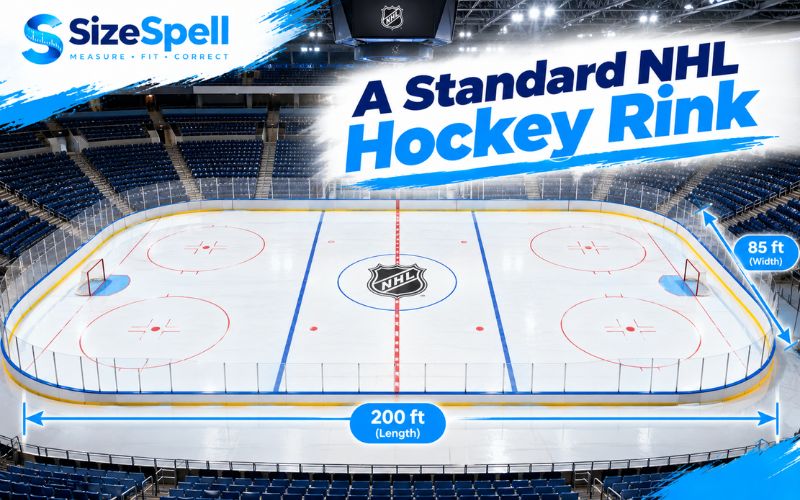
An NHL rink is 200 feet long and 85 feet wide. This is one of the cleanest exact matches on the list.
If you have ever watched a hockey game, you know how far a player has to skate to get from one goal to the other. That whole trip is 200 feet. For visualization, this is hard to beat because the ice surface is easy to picture and the boards give you clear start and end points.
6. About Two-Thirds of a Football Field
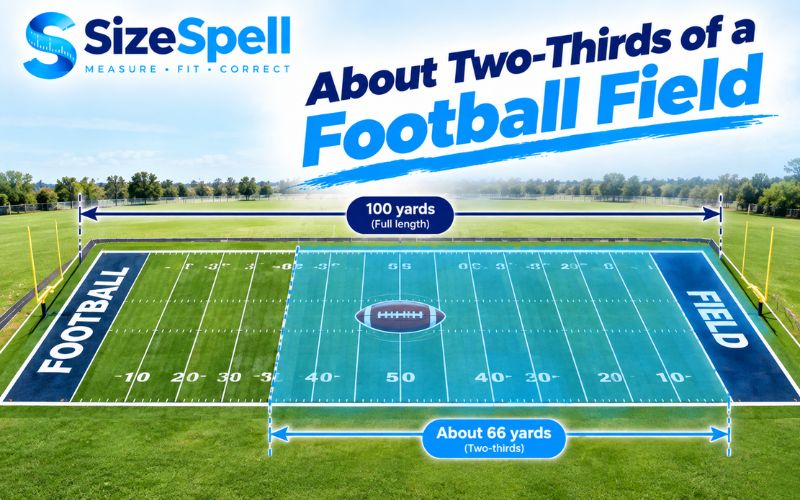
An American football field is 300 feet between the goal lines, or 360 feet including both end zones. Two hundred feet is 66.67 yards, so it is two-thirds of the distance from goal line to goal line.
If you stand on one goal line and walk out 200 feet, you will reach about the opposing team’s 33-yard line. This comparison is great for anyone who grew up watching the game, and it shows how a 200-foot distance fits into a space you already know.
7. A Boeing 787-9 Dreamliner

The Boeing 787-9 is about 206 feet long, nose to tail. That is only a few feet more than 200.
Next time you board a wide-body jet, look down the aisle. The whole cabin and cockpit together are close to 200 feet. Smaller jets are shorter. A Boeing 757-300 is about 178 feet, and the giant 747-8 stretches roughly 250 feet.
8. A Coast Redwood Tree

Coast redwoods are the tallest trees on Earth, and a mature one in a healthy grove commonly reaches 200 feet or more. Some stand well over 300 feet.
Imagine the redwood falling flat. That trunk would stretch about as long as a hockey rink. Standing at the base and looking up at a 200-foot tree is one of the best ways to feel the scale, because your neck will tell you how big it is.
9. A Little Taller Than the Drop at Niagara Falls
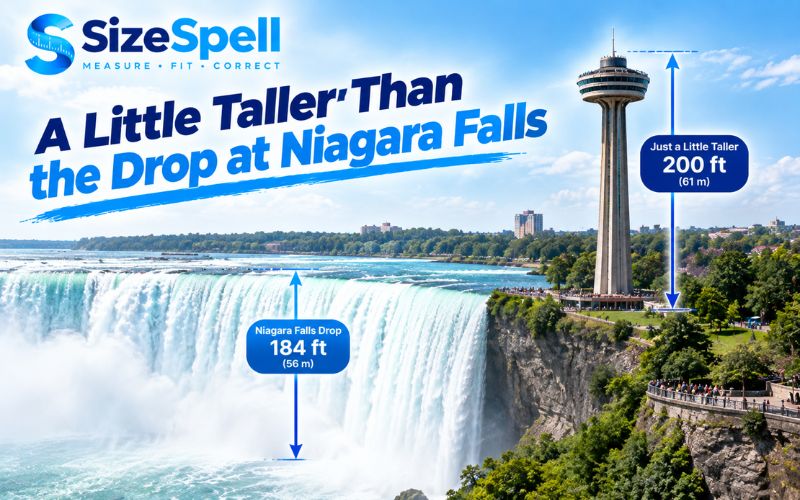
Many sources say Niagara Falls is about 200 feet tall. The real number is lower and depends on how you measure. The Horseshoe Falls drops roughly 167 to 188 feet depending on the source and whether you include the pool below. The American Falls ranges from about 70 to 110 feet, because of the rock pile at its base.
So 200 feet is slightly taller than the biggest drop at Niagara. If you have visited, picture the Horseshoe Falls and then add one more story on top. That is your 200-foot mark.
Quick Summary of the Nine Comparisons
| # | Comparison | Approximate Length | Match Quality |
| 1 | Five 40-ft shipping containers | 200 ft | Exact |
| 2 | Four 50-ft boxcars | 200 ft | Close (lengths vary) |
| 3 | Wright brothers’ third flight | ~200 ft | Close |
| 4 | Portland city block | ~200 ft | Close |
| 5 | NHL hockey rink (length) | 200 ft | Exact |
| 6 | Football field (goal line to opposing 33) | ~200 ft | Exact math |
| 7 | Boeing 787-9 | ~206 ft | Close |
| 8 | Mature coast redwood | 200+ ft | Typical |
| 9 | Niagara Falls drop | 167–188 ft | Slightly shorter |
How Big Is 200 Feet?
When people ask how big 200 feet is, they usually mean area or size, not just length. A length alone does not tell you the area, so here is how it works.
If you have a square plot that is 200 feet on each side, the area is 40,000 square feet. That is about 0.92 acres, which is a little less than one acre. An acre is 43,560 square feet.
A lot that is 100 feet wide and 200 feet deep covers 20,000 square feet, or a little under half an acre. That is a very common size for a suburban parcel.
Here is a small table to make this concrete:
| Shape | Dimensions | Area |
| Square | 200 ft × 200 ft | 40,000 sq ft (0.92 acre) |
| Rectangle | 200 ft × 100 ft | 20,000 sq ft (0.46 acre) |
| Rectangle | 200 ft × 50 ft | 10,000 sq ft (0.23 acre) |
| Sidewalk | 200 ft × 4 ft | 800 sq ft |
| Fence line | 200 ft | 200 linear feet |
For sidewalks, driveways, and patios, area matters because it drives the cost of concrete, gravel, or pavers. A four-foot-wide walkway that runs 200 feet is 800 square feet. If you pour it four inches thick, you need roughly 10 cubic yards of concrete. Always add 5 to 10 percent for waste and uneven ground.
How Tall Is 200 Feet?
Height feels very different from length. Standing at the base of something 200 feet tall, you feel small. Here is how that height compares with famous structures and common buildings.
Buildings: A typical story in a commercial building is about 10 to 12 feet. That puts 200 feet at roughly 17 to 20 stories. In residential buildings with lower ceilings, it can reach 20 stories or a bit more.
Statue of Liberty: The statue stands about 151 feet from the base of the figure to the tip of the torch. So 200 feet is taller than Lady Liberty herself, though the full monument with its pedestal reaches about 305 feet.
Drone altitude: In the United States, the FAA limit for recreational drones is 400 feet above ground level. So 200 feet is exactly halfway to the legal ceiling. That is a useful number to remember if you fly a camera drone, because the picture looks very different at 200 feet than it does at 50.
Underwater: Water pressure rises about one atmosphere for every 33 feet of depth. At 200 feet you are experiencing roughly seven times the pressure at the surface. That is deeper than recreational scuba limits, which stop at 130 feet.
How Far Is 200 Feet?
Distance becomes real when you tie it to time and effort. Here is a table to help you plan.
| Activity | Speed | Time to Cover 200 ft |
| Slow walk | 2 mph | ~68 seconds |
| Normal walk | 3 mph | ~45 seconds |
| Brisk walk | 4 mph | ~34 seconds |
| Easy jog | 6 mph | ~23 seconds |
| Steady run | 10 mph | ~14 seconds |
| Fast sprint | 15 mph | ~9 seconds |
A few real-life examples:
- Parking: If you park 200 feet from the store entrance, you add less than a minute to your trip.
- Camping: A common recommendation is to set up your campsite and bathroom area at least 200 feet from water sources, about 70 adult steps. Always check local rules.
Environment changes perception, too. Across an open field, 200 feet looks short. Through dense forest or a crowded street, it feels much farther because your eyes have nothing to measure against.
Also Read This How Big Is 3mm? 12 Everyday Objects for Comparison
200 Feet Comparison Table
Here is a single table you can screenshot. It places 200 feet against everyday objects so you can see how many of each fit in the distance.
| Object | Typical Length | How Many Fit in 200 Feet |
| Average car | 15 ft | ~13 cars |
| Pickup truck | 19 ft | ~10 trucks |
| School bus | 35–40 ft | ~5 buses |
| Semi-truck and trailer | 70 ft | ~3 trucks |
| 40-ft shipping container | 40 ft | 5 containers |
| Bowling lane | 60 ft | ~3.3 lanes |
| NBA basketball court | 94 ft | ~2.1 courts |
| Baseball base path | 90 ft | ~2.2 paths |
| Parking space | 9 ft wide | ~22 spaces |
| Adult step | 2.5 ft | ~80 steps |
| Adult human height | 5.7 ft | ~35 people |
200 Feet vs Other Common Distances
Sometimes you want to see 200 feet next to larger and smaller numbers. This table gives you the scale.
| Distance | In Yards | In Meters | Compared With 200 ft |
| 50 feet | 16.7 yd | 15.2 m | One quarter |
| 100 feet | 33.3 yd | 30.5 m | Half |
| 200 feet | 66.7 yd | 61 m | Baseline |
| 300 feet | 100 yd | 91.4 m | 1.5 times |
| 500 feet | 166.7 yd | 152.4 m | 2.5 times |
| 1,000 feet | 333.3 yd | 304.8 m | 5 times |
| 1 mile (5,280 ft) | 1,760 yd | 1,609 m | 26.4 times |
Two related mix-ups are worth remembering:
- 200 feet vs 200 yards: 200 yards is 600 feet, which is three times longer.
- 200 feet vs 200 meters: 200 meters is about 656 feet, which is more than three times longer.
If a plan, sign, or contract uses one unit and you read it as another, the error is big. Always check the unit.
How to Measure 200 Feet Without a Tape Measure
You do not always carry a 200-foot tape. Here are three practical methods, from rough to more precise. Each works well for fencing, garden layout, event setup, or checking a property line.
Method 1: Using Steps
This is the oldest trick, and it works well once you calibrate.
- Measure a known distance. Lay out 30 feet on a flat surface using a tape measure or a measured room.
- Walk it normally. Count your steps. Do it three times and take the average.
- Find your step length. Divide 30 by your average step count. For example, if it takes 12 steps, your step is 2.5 feet.
- Calculate for 200 feet. Divide 200 by your step length. At 2.5 feet per step, that is 80 steps.
Practice a few times to get consistent. Walk at your natural pace on level ground. Hills, grass, and carrying weight all change your stride, so recalibrate if conditions change.
A quick reference for step counts:
| Step Length | Steps for 200 ft |
| 2.0 ft | 100 steps |
| 2.25 ft | ~89 steps |
| 2.5 ft | 80 steps |
| 2.75 ft | ~73 steps |
| 3.0 ft | ~67 steps |
Method 2: Using Floor Tiles
If you are indoors, tiles can act as a ruler. Many floor tiles are 12 inches, which makes each tile exactly one foot. In a long hallway of 12-inch tiles, 200 tiles is 200 feet.
Larger tiles work too:
- 12-inch tiles: 200 tiles
- 18-inch tiles: about 134 tiles
- 24-inch tiles: 100 tiles
Warehouses, malls, schools, and hospitals often have long corridors with a repeating tile or ceiling grid. Count the tiles or panels along the length. Ceiling panels are often 2 feet by 2 feet or 2 feet by 4 feet, which are easy to count and convert.
Check the actual tile size first by measuring a single one. Grout lines add a little, so a tile listed as 12 inches may measure slightly more when you count the joint.
Method 3: Using Known Objects
This method is useful outdoors when nothing else is available. Pick an object whose length you know and count how many fit.
- Cars: About 13 average cars in a line.
- Fence panels: Standard wood panels are 6 or 8 feet wide, so you need about 33 six-foot panels or 25 eight-foot panels.
- Road lane lines: In many places, dashed lane stripes are 10 feet long with a 30-foot gap, a 40-foot cycle. Five cycles equals 200 feet. Rules differ by country, so confirm locally.
For a better result, pair two methods. For instance, count your steps and then verify using fence panels. If both agree within a few feet, you are in good shape.
When You Need More Accuracy
For legal boundaries, building layouts, or anything that affects safety or cost, do not rely on estimates. Use one of these:
- Measuring wheel: Cheap, easy, and accurate to within a foot or two over 200 feet on smooth ground.
- Laser distance measurer: Fast and accurate indoors or on clear lines of sight.
- Open-reel tape: A 200-foot fiberglass tape is the classic tool for surveyors and builders.
- Phone mapping apps: Handy for a rough check, but GPS can be off by 10 feet or more.
- Licensed surveyor: The right choice for property lines and easements.
One common mistake is to chain a short tape eight or nine times to get 200 feet. Each small error adds up, and you can end up off by several inches or more. A longer tool is better.
FAQs
How many meters is 200 feet?
200 feet equals 60.96 meters. Multiply feet by 0.3048 for an exact answer, or by 0.3 for a quick estimate.
How many yards is 200 feet?
200 feet is 66.67 yards. Divide feet by three.
How many steps is 200 feet?
About 80 steps for an average adult with a 2.5-foot stride. Measure your own stride for a better number.
How long does it take to walk 200 feet?
Roughly 45 seconds at a normal pace of 3 miles per hour.
Is 200 feet the same as 200 yards or 200 meters?
No. 200 yards is 600 feet, and 200 meters is about 656 feet. Always check the unit.
How many stories is 200 feet?
About 17 to 20 stories, assuming 10 to 12 feet per floor.
How many football fields is 200 feet?
About two-thirds of one field, measured goal line to goal line (300 feet).
Conclusion
Two hundred feet is 60.96 meters, 66.67 yards, or 2,400 inches. In real life it is about five shipping containers, one NHL rink, a short city block in Portland, or the length of the Wright brothers’ third flight. It is taller than the Statue of Liberty, close to the length of a Boeing 787-9, and about the height of a 20-story building.
Keep three anchors in your pocket: 13 cars, 80 steps, and 45 seconds of walking. Those alone will get you through most everyday situations. When the stakes are higher, such as property lines, fencing, or building work, grab a measuring wheel or call a surveyor.
The more you practice, the more natural this distance feels. Next time you walk across a parking lot or down a long hallway, count your steps. You will be surprised how quickly 200 feet becomes something you can see in your head.

1 thought on “How Long Is 200 Feet? 9 Real-World Comparisons”