


Meta description: How big is 5mm? See 10 real objects that measure 5mm, a conversion table, and three easy ways to measure it with or without a ruler.
You see a size on a product page. It says 5mm. You nod, then realize you have no clear picture of it in your head.
That happens to almost everyone. Five millimeters is tiny enough to vanish under a sofa, yet big enough to decide whether a screw fits, a bead threads, or a piece of jewelry looks right.
This guide fixes that. You will learn what 5mm looks like in real life, how it converts to inches and other units, and which everyday objects share this exact size. You will also pick up three simple ways to measure 5mm, even when no ruler is nearby.
Let’s start with the basics.
5mm at a Glance

5mm is five millimeters, which equals 0.5 centimeters, 0.005 meters, or about 0.197 inches. It is roughly one-fifth of an inch and a little less than the width of a pencil eraser.
Here is the quick version:
- Metric: 5 millimeters = half a centimeter
- Imperial: about 0.197 inches, or close to 13/64 of an inch
- Looks like: the width of a small pea, a standard 5mm LED, or one square on a lot of school graph paper
- Feels like: about the thickness of a stack of three quarters
One millimeter is one-thousandth of a meter. So the number looks small because it is small. Ten of these little steps make a centimeter, and 25.4 of them make a full inch.
If you remember only one thing, remember this: 5mm is slightly smaller than 3/16 of an inch plus a hair, and noticeably smaller than 1/4 inch. That gap causes plenty of wrong-size purchases.
Conversion Table
Use this table when you need a fast answer. All values are rounded where noted.
| Unit | Value for 5mm |
| Millimeters (mm) | 5 |
| Centimeters (cm) | 0.5 |
| Meters (m) | 0.005 |
| Micrometers (µm) | 5,000 |
| Inches (decimal) | 0.19685 (≈ 0.197) |
| Inches (fraction) | ≈ 13/64 |
| Feet | 0.0164 |
| Yards | 0.00547 |
| Typographic points | ≈ 14.17 |
| Screen pixels (96 dpi) | ≈ 18.9 |
The formula is simple. Divide millimeters by 25.4 to get inches. So 5 ÷ 25.4 = 0.19685.
Going the other way, multiply inches by 25.4. A fifth of an inch (0.2 in) comes out at 5.08mm, which is why people often call 5mm “about a fifth of an inch.”
How to See 5mm Right Now Using Your Hand
You carry a rough 5mm guide on you at all times. It is your hand.
Look at your pinky fingernail. On many adults, the nail is about 10mm wide. Cut that width in half and you land near 5mm.
Try it this way:
- Hold your hand in front of you with the palm facing you.
- Look at the widest part of your pinky nail.
- Picture a line down the middle.
- One half of that nail is about 5mm.
There is a catch. Hands vary, and so do nails. Children, teens, and adults all differ.
So calibrate once. Hold a ruler against your nail and check the width. If yours is 9mm or 11mm, you now know your personal adjustment. After that, you can estimate sizes anywhere.
Another hand trick works with the thin edge of a fingernail clipping or the tip of a sharpened pencil, but the pinky method stays the most reliable for most people.
10 Real Objects That Are Exactly 5mm
A quick note before the list. Manufactured items carry tolerances, which means a “5mm” part may measure 4.95mm or 5.05mm in practice. Natural items like pearls vary even more. Each entry below uses 5mm as the standard or nominal size, so you can trust the number while still checking with calipers when precision matters.
1. 5mm LED Bulb

The classic 5mm LED is one of the most recognizable small parts in electronics. Makers also call it the T-1¾ size, and the clear or colored dome is 5mm across.
You will find these in hobby kits, indicator panels, and toy circuits. A typical red one runs at about 2 volts and 20 milliamps, with a resistor in line to protect it.
The flange at the base is a bit wider, around 5.8mm to 6mm, so measure the dome and not the rim. Panel holes for these LEDs are normally drilled slightly larger than 5mm so the part slides in.
2. M5 Bolt

The “M” in M5 stands for metric thread, and the 5 is the outer thread diameter in millimeters. That makes the shaft of an M5 bolt 5mm wide.
The standard coarse pitch is 0.8mm. Each full turn moves the bolt forward by that distance.
Two tool details trip people up:
- An M5 socket head cap screw takes a 4mm hex key.
- An M5 hex head bolt usually needs an 8mm wrench.
So the bolt measures 5mm, but the tool does not. Keep that in mind before you raid the toolbox.
3. 5mm Drill Bit
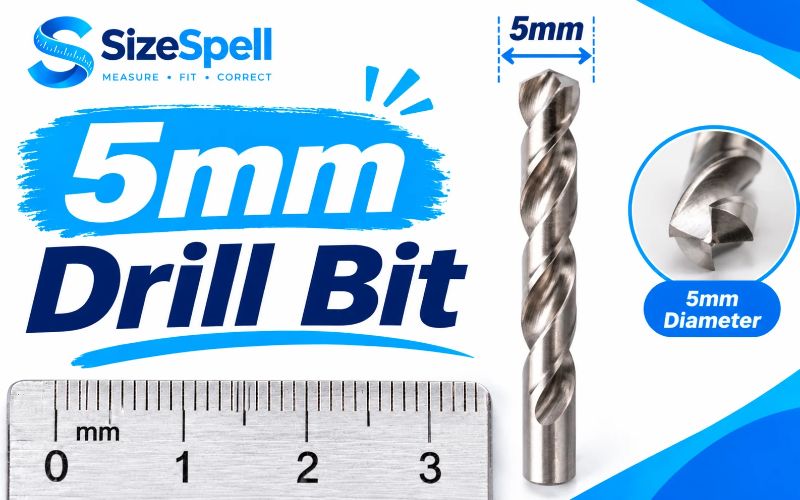
A 5mm drill bit cuts a hole 5mm wide. It is a regular guest in woodworking, metalwork, and furniture assembly.
Metal workers often use it as the tap drill for an M6 thread, since an M6 x 1.0 tap needs a 5mm pilot hole. Woodworkers reach for it when they need holes for small dowels or shelf pins.
In the imperial system, the nearest bits are 3/16 inch (4.76mm) and 13/64 inch (5.16mm). The 5mm size sits right between them. Swapping one for the other changes the fit, so read the label.
4. 5mm Pearl
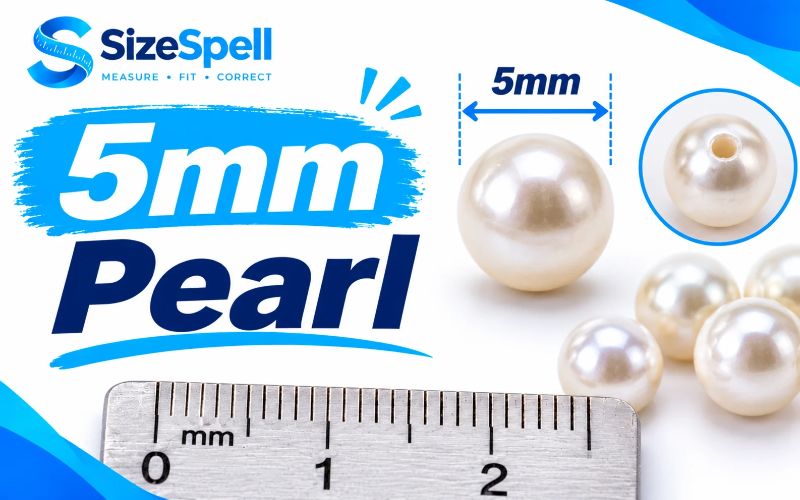
A 5mm pearl is a small, delicate size. Jewelers use it for studs, pendants, and bracelet accents.
Natural and cultured pearls are never perfectly uniform, so sellers usually list ranges like 4.5–5mm or 5–5.5mm. A true round 5mm pearl is on the petite side compared with the 7–8mm pearls common in classic necklaces.
If you shop online, check whether the listing gives the size as diameter. That one detail separates a pearl that looks refined from one that looks lost.
5. 5mm Round Bead
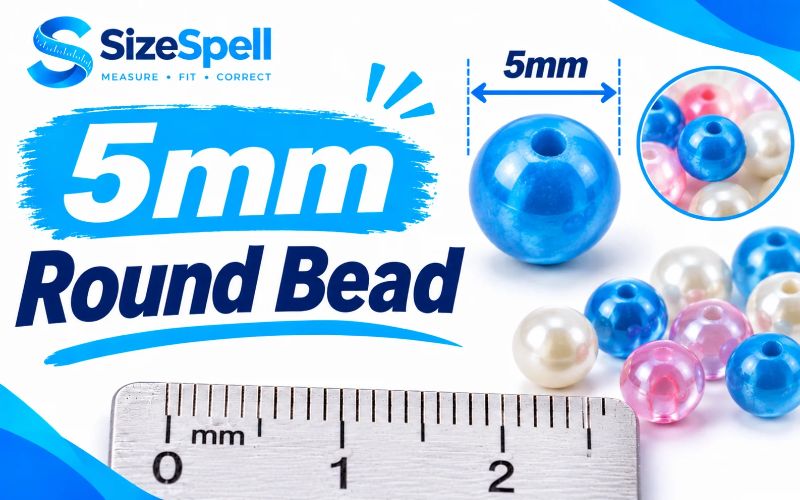
Beads are a friendly way to see 5mm. Glass, wood, acrylic, and metal beads in this size are sold by the thousands for bracelets, tassels, and embroidery.
Here is a handy bit of math. Line up 10 beads and you have 50mm, which is 5cm. Line up 100 and you have half a meter.
The hole through the center is usually 1mm to 2mm. That is wide enough for thread, wire, or elastic cord, but too narrow for thick leather.
6. 5mm Jump Ring

Jump rings are small open loops that join charms, clasps, and chain. Sellers describe them by inner diameter, so a 5mm jump ring has a 5mm opening.
The wire is typically around 0.7mm to 1mm thick. The outer width is therefore a little larger than 5mm.
One tip from jewelry-making practice: open the ring by twisting the ends sideways, never by pulling them apart. Pulling weakens the metal and leaves a misshapen circle.
7. 5mm Ball Bearing
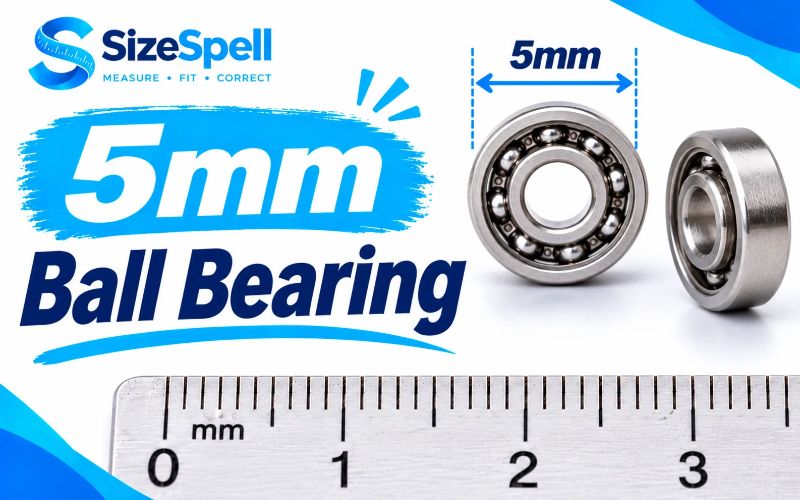
Ball bearings come in two flavors for this size. First, there are loose steel balls with a 5mm diameter. Second, there are bearings with a 5mm bore, meaning the hole in the middle is 5mm.
A well-known example is the 625 bearing, which has a 5mm bore, a 16mm outer diameter, and a 5mm width. It shows up in 3D printers, skateboards, and small machines. The 685 bearing also has a 5mm bore with an 11mm outer diameter and 5mm width.
Because a bearing needs to spin smoothly, tolerances are tight. That makes it one of the more accurate 5mm items on this list.
8. 5mm Hex Key

A hex key, also called an Allen key, is measured across its flats. A 5mm hex key is 5mm from one flat side to the opposite flat side.
The corners measure a bit more, about 5.77mm, which is why you should never measure corner to corner.
This key fits M6 socket head cap screws. It also appears in bike repair kits, where 5mm is among the most-used sizes for seat posts, stems, and bottle cages.
9. 5mm Dowel Pin
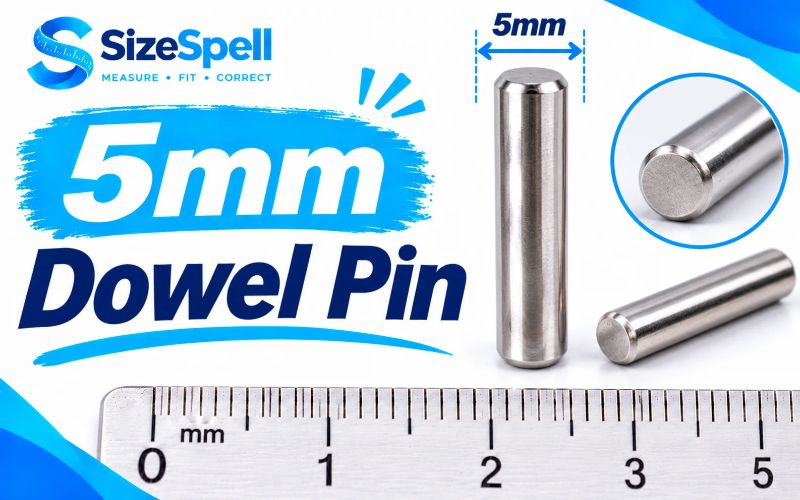
A dowel pin is a short rod that lines up two parts. Wooden dowels, often beech, come in 5mm and serve in furniture joints. Steel dowel pins, made to ISO standards, serve in machinery.
The pin is typically a snug fit in a 5mm hole. For wood, makers cut small grooves along the pin so extra glue can escape.
Want to test your eye? Compare a 5mm dowel with a standard pencil. The pencil is thicker, usually 7mm or so, and the difference shows up fast.
10. 5mm Rivet
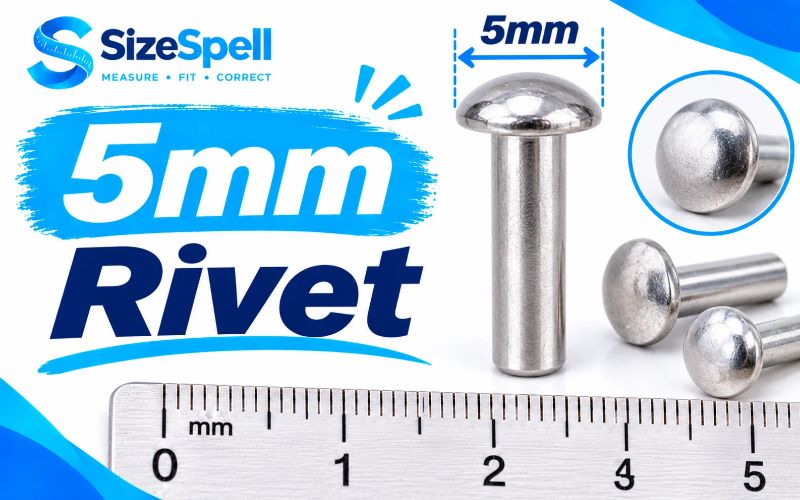
Rivets permanently join sheets of metal, plastic, or leather. Metric blind rivets are sold in sizes like 3.2mm, 4mm, 4.8mm, and 5mm.
Many shops stock the 4.8mm size, which equals 3/16 inch. A true 5mm rivet also exists and is common in some regions and trades.
The drilled hole should be slightly bigger than the rivet body, usually by a tenth or two of a millimeter. Too tight and the rivet will not seat. Too loose and it will not grip.
More 5mm Size Guides
Once you know the 10 objects, it helps to put 5mm in a wider frame. The sections below show how it compares with nearby sizes, other units, and everyday life.
5mm Compared to Common Sizes
Sizes feel clearer next to their neighbors. This table places 5mm among the sizes people often confuse it with.
| Size | Inches (approx.) | Familiar reference |
| 3mm | 0.118 | A sesame seed or a small drill bit |
| 4mm | 0.157 | An M4 screw shaft |
| 5mm | 0.197 | A 5mm LED, a hex key, a small pea |
| 6mm | 0.236 | Close to 1/4 inch (6.35mm) |
| 8mm | 0.315 | A large pea or a wine cork’s narrow end |
| 10mm | 0.394 | A pinky fingernail width |
| 12.7mm | 0.500 | Exactly half an inch |
Also Read This How Tall Is a Monster Can? Height and Size Guide
Notice how close 5mm, 3/16 inch, and 13/64 inch sit. They look nearly identical, yet each behaves differently when you thread a bolt or drill a hole.
Coins also help. A US penny is about 1.52mm thick, a nickel about 1.95mm, a dime about 1.35mm, and a quarter about 1.75mm. Stack three quarters and you get roughly 5.25mm. Stack three pennies and add five sheets of printer paper (about 0.1mm each) and you land very near 5mm.
A credit card is about 0.76mm thick. It takes between six and seven of them to build a 5mm pile.
How Big Is 5mm in Other Units?
Beyond inches, 5mm shows up in many unit systems.
- Centimeters: 0.5 cm
- Meters: 0.005 m
- Micrometers (microns): 5,000 µm
- Nanometers: 5,000,000 nm
- Feet: about 0.0164 ft
- Yards: about 0.0055 yd
- Points (design and print): about 14.2 pt
- Pixels (96 dpi screen): about 19 px
The pixel and point conversions matter to designers. A 5mm border on a printed flyer looks different from 5mm on a phone screen, since screen density changes the real-world size.
A human hair is about 0.07mm thick, so 5mm is roughly 70 hairs side by side. That gives you a sense of how much space 5mm really holds.
Where 5mm Shows Up Without You Noticing
You meet this size more often than you think. Here are common places:
- Electronics: 5mm LEDs, small buttons, and thin cable diameters.
- Hardware: M5 screws, 5mm drill bits, and 5mm hex keys.
- Jewelry: Pearls, gemstones, beads, and jump rings. Body jewelry in 4 gauge is about 5.2mm, so 5mm sits right near it.
- Stationery: Many European notebooks use graph paper with 5mm squares. Hold a page up to the light and you can count your own ruler.
- Technology: The thinnest tablets in recent years are around 5mm thick, such as the 13-inch iPad Pro at about 5.1mm. Most phones are thicker, usually 7mm to 9mm.
- Kitchen: A 5mm cut for diced vegetables, or rolled cookie dough at about that thickness for crisp edges.
- Nature: Small seeds, peppercorns, lentils, ladybugs, and many ants fall between 3mm and 8mm.
- Health: Doctors often track small growths or stones in millimeters. A 5mm measurement can be meaningful there, but only a medical professional should interpret it. If you notice a change in a skin spot or have symptoms, book an appointment instead of guessing from a size chart.
5mm at a Glance: Biowiki Reference Chart
Use this compact chart as a bookmark-worthy cheat sheet.
| Category | 5mm Fact |
| Definition | 5 millimeters, or 0.5 cm |
| Inch value | 0.19685 in (about 13/64 in) |
| Nearest standard fractions | 3/16 in (4.76mm) and 1/4 in (6.35mm) |
| Hand estimate | Half of a typical pinky nail width |
| Common objects | LED, M5 bolt, bead, hex key, dowel pin |
| Coin stack | About 3 quarters (5.25mm) |
| Paper stack | About 50 sheets of 80 gsm paper |
| Tolerance tip | Real parts can vary by ±0.05mm or more |
Metric vs. Imperial: Converting 5mm Easily
The metric system counts in tens. The imperial system counts in fractions and feet. That mismatch causes most confusion when a 5mm part meets an inch-based tool.
Here are three quick mental shortcuts:
- Call 5mm a fifth of an inch. It is off by only 0.08mm.
- Remember 25mm is about one inch. So 5mm is one-fifth of that.
- Use 13/64 for fractional rulers. It is the closest 64th of an inch to 5mm.
For exact work, use the formula: millimeters ÷ 25.4 = inches.
Also watch out for these near-misses, which cause the most wrong-size buys:
| Metric size | Imperial neighbor | Difference |
| 5mm | 3/16 in (4.76mm) | 0.24mm smaller |
| 5mm | 13/64 in (5.16mm) | 0.16mm larger |
| 5mm | 1/4 in (6.35mm) | 1.35mm larger |
A gap of 0.2mm may sound trivial. On a tight-fitting pin or bearing, it decides whether the part goes in at all.
How to Measure 5mm Without a Ruler
No ruler? No problem. These three methods get you close, and each has a different level of accuracy.
Method 1 — Pinky Fingernail Tip
This is the fastest option when you have nothing else.
- Check your pinky nail against a ruler once and note its width.
- Divide that width by two.
- Use that half-width as your 5mm guide.
If your nail is 10mm wide, half of it is 5mm. If it is 9mm, half is 4.5mm, so adjust by eye.
Accuracy: roughly ±1mm. Good enough for crafts, cooking, and casual checks. Not good enough for machine parts.
Method 2 — Use a 5mm Object
Save a trusted reference in a drawer. A 5mm hex key, a 5mm drill bit, or an M5 bolt works well. Keep it in your pocket toolbox.
To use it, hold the item next to the thing you are checking. If the two match, you have 5mm.
Squared notebook paper works too, if it has 5mm squares. One square equals 5mm across, and ten squares equal 5cm.
Accuracy: roughly ±0.2mm when the reference is a quality tool. Check that your reference is real by measuring it once with a caliper.
Method 3 — Using a Ruler
A ruler is the simplest accurate tool. Here is how to read it:
- Find the metric side, marked in centimeters and millimeters.
- Look at the small lines between two numbers. Each one is 1mm.
- Count five of them from your starting point.
- On many rulers, the fifth line is slightly longer. That marks the half-centimeter.
Two tips improve accuracy:
- Start at the 1cm line instead of the very end. Worn edges on cheap rulers add small errors.
- View the ruler straight on. Looking from an angle causes parallax, which shifts the reading.
For extra precision, use a digital or vernier caliper. A decent caliper reads to 0.01mm or 0.02mm, which is more than enough to tell a 5mm part from a 5.16mm one.
Also be careful with printable rulers. Printers can scale a page, so measure your printed 5cm line against a real ruler before you trust it.
5mm Quick Reference
Bookmark this list for quick checks:
- Metric: 5mm = 0.5cm = 0.005m
- Inches: 0.197 in, or about 13/64 in
- Fifth-of-an-inch rule: 0.2 in = 5.08mm
- Hand guide: half of a pinky nail width
- Coin stack: about three quarters
- Credit cards: six to seven stacked
- Hex key: 5mm fits M6 socket cap screws
- M5 bolt: 5mm shaft, 4mm hex key, 8mm wrench
- Drill bit: 5mm for M6 tap holes
- Best tool for accuracy: a caliper
Conclusion
Five millimeters is small, but it is far from vague. It is half a centimeter, about 0.197 inches, and roughly the width of half your pinky nail.
You now know ten real things that share the size: a 5mm LED, an M5 bolt, a 5mm drill bit, a pearl, a bead, a jump ring, a ball bearing, a hex key, a dowel pin, and a rivet. You also know how 5mm compares with 3/16 inch, 13/64 inch, and 1/4 inch, which saves you from the most common sizing mistakes.
Next time a product says 5mm, you will have a picture in mind. For quick estimates, use your hand or a reference object. For work that has to fit, grab a ruler or caliper and confirm the number.

1 thought on “10 Everyday Objects That Measure Exactly 5mm”